Entonces la mar
Alejandra Glez proposes a new way of looking at her relationship with the sea.
Not from the tension that defined earlier stages of her practice, but from a place of calm. From the serenity of the woman she is today, who chooses to return to the child she once was—not out of nostalgia, but in order to reclaim a freer, less conditioned way of inhabiting the world.
Entonces la mar activates this dual movement. It refers back to childhood, yet it also opens a suspended consequence: then… what changes when we look from that place?
The artist situates us at the shoreline. Not in the depth or vastness that marked previous phases of her work, but at the point where water meets solid ground and scale shifts. The shoreline is not a boundary; it is the place where one decides how to stand.
For the adult, it may be a frontier. For the child, a territory of sand, play, and exploration. This difference in perspective sustains the exhibition’s trajectory.
A line of sand runs through the exhibition space, between wall and floor, between artwork and viewer. The installation transforms the concept into a physical experience. The shoreline does not separate; it compels positioning. It can be perceived as an edge or as an opening. From this point, Alejandra Glez’s trajectory is no longer read solely as an artistic narrative but understood as a personal process.
The family photographs from childhood do not function as sentimental archive, but as origin. Presence and absence coexist within them. The innocence that appears is not naïveté, but the initial energy of her relationship with the sea.
A sound piece introduces another layer without offering explanation. Three temporalities coexist: childhood; adolescence—through a recorded reunion with her mother—and a Yoruba chant performed by Lázaro Ros. They do not construct a linear narrative; they resonate. Sound shifts the experience beyond the visual plane and relocates memory within another register.
The subsequent works acquire a distinct meaning in this context. Mar negro no longer insists on darkness, but on the capacity to emerge from it. Entre redes internalizes the boundary: the sea remains open behind, yet the gaze lingers on the net. The question shifts from what surrounds the artist to the standpoint from which she looks.
In Océano, the gesture of lifting one’s head above the water to breathe encapsulates this transformation. It is not escape. It is a conscious pause before submerging once again.
The exhibition does not conclude; it opens outward. The sketches gathered in Por venir sustain the work in motion. And Trocitos de mar extends that openness to the viewer: the text is fragmented into multiple pieces that can be taken away—not as a souvenir, but as a gesture of continuity.
From the shoreline, the sea changes scale. And so does the way we look at it.
Trocitos de mar (by Alejandra Glez)
If each small fragment of this sea could hold our most intimate wishes—the loves that care for bodies, shared health, the well-being that soothes from within.
If each small wave carried the memory of a summer breeze, soft against salted skin, suspended time, the slow light of day. A mother’s steady hand. A brother’s embrace accompanying steps taken together—without haste, without fear, with open and gentle trust. Grandparents laughing at the shore, playing with wet sand, building fragile castles that fall and begin again, always. A father’s smile watching from afar.
If each drop of salt water could cleanse ancient fears, the weight of pain, silent loss.
If the sea made space to release what hurts, what is missing, what trembles, what resists, what remains alive, what loves without measure, what still waits.
Then the sea would always be beautiful—abundant, powerful, generous, maternal, deep, protective, present—always itself, full of love.
Artworks


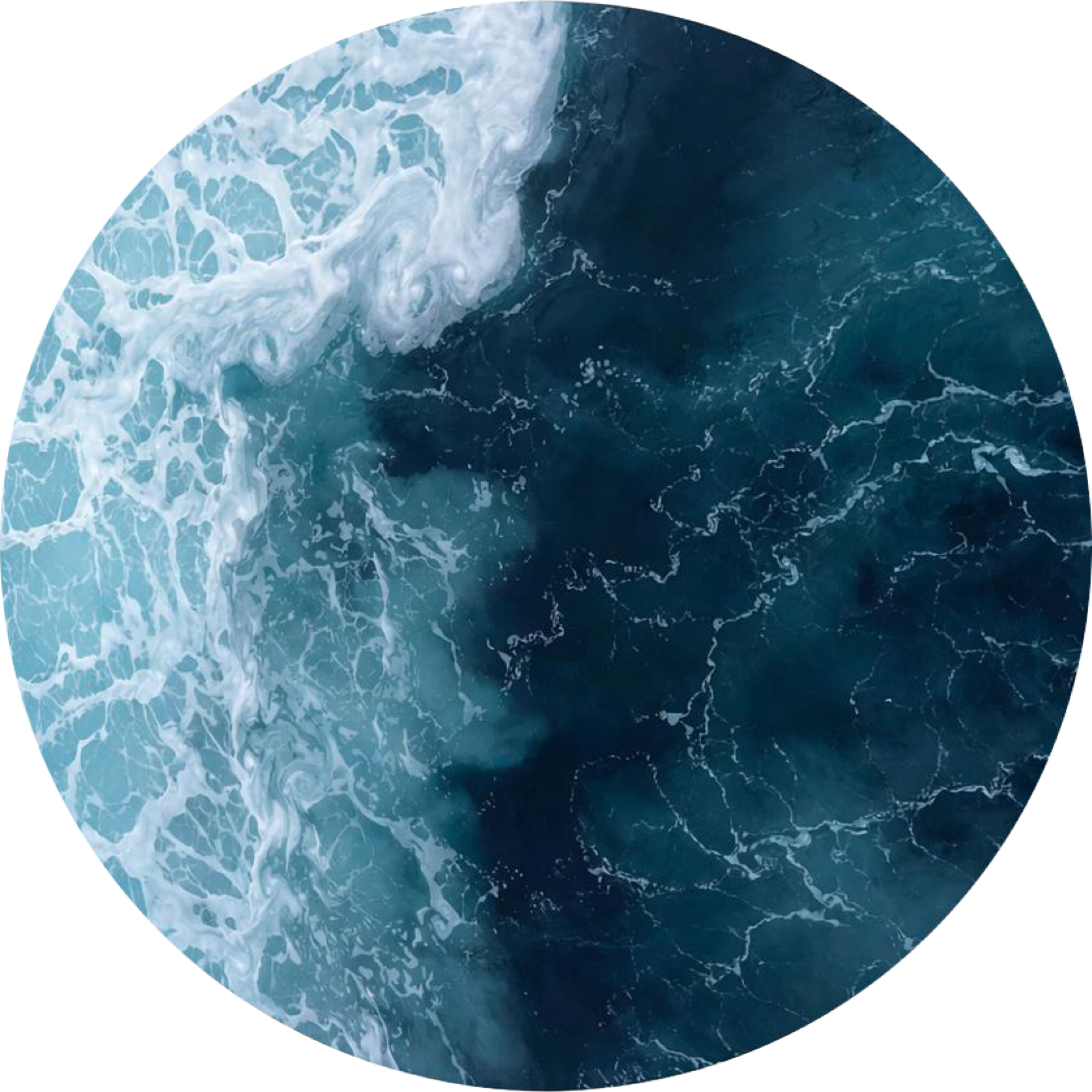


Series of 91, signed by the artist.